
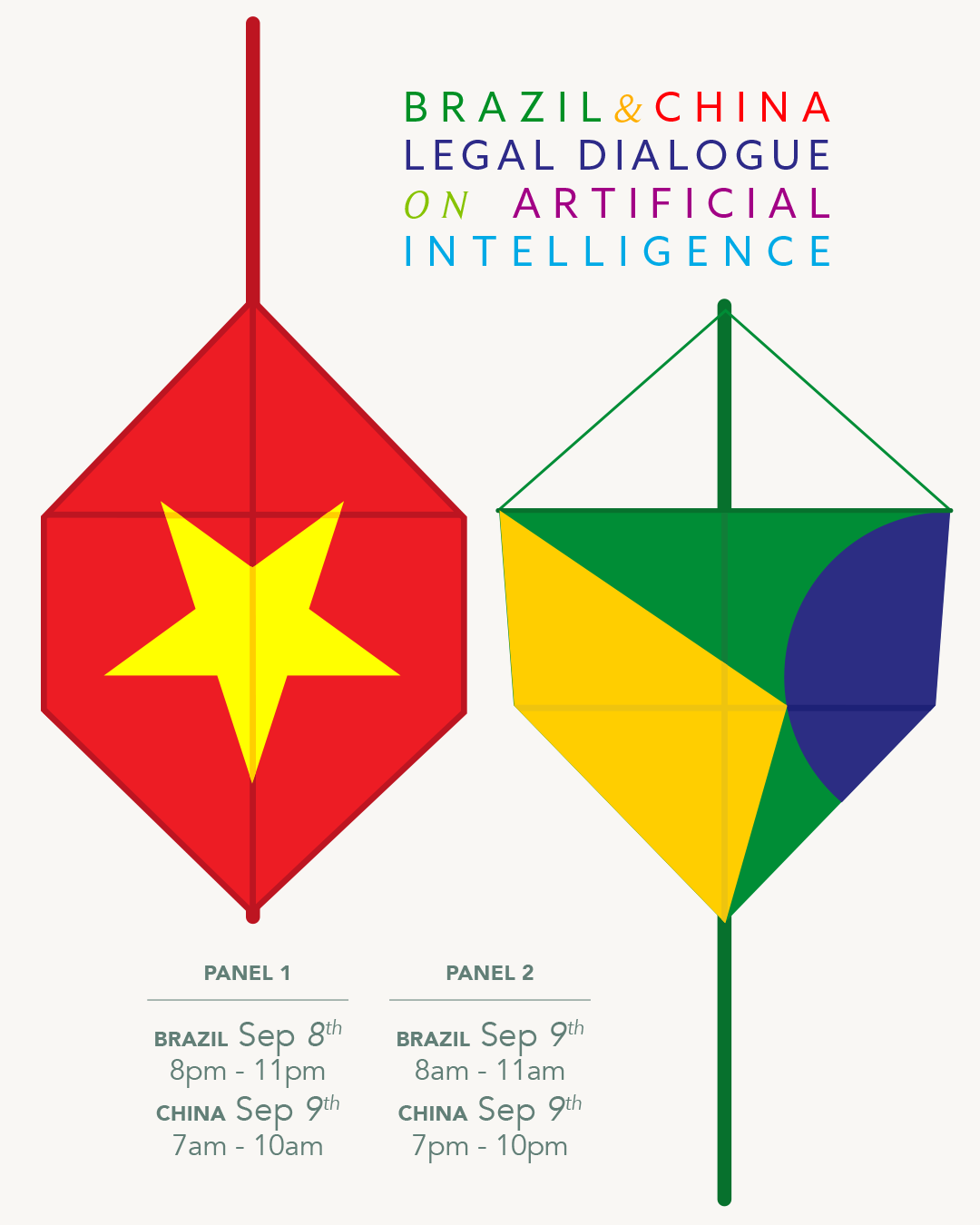
The Brazil–China Legal Dialogue on Artificial Intelligence: Governance, Regulation and Innovation is an international initiative aimed at fostering dialogue and exchange on the development, regulation, and governance of artificial intelligence, with a particular focus on cooperation between Brazil and China.
Co-led by Juliano Maranhão and Cristina Godoy, the event brought together academics, researchers, and experts from different countries to discuss different approaches to AI governance and the legal and institutional challenges emerging from its development. The initiative involved institutional participation from the Legal Wings Institute, the University of São Paulo (USP), Tsinghua University, East China University of Political Science and Law (ECUPL), the University of Hong Kong (HKU), and the International Research Centre on Artificial Intelligence under the Auspices of UNESCO (IRCAI).
The second panel, “Building AI Governance: Regulatory Frameworks and Institutional Models in Brazil and China,” focused on emerging regulatory frameworks and institutional models for AI governance. The discussion addressed AI legislation and regulatory strategies, risk-based governance, data governance and cross-border data flows, the use of AI in the public sector, and opportunities for international cooperation, particularly between Brazil and China.
Panelists: Yan Cui (Gansu University of Political Science and Law), Xiuyan Fei (Institute for AI and the Rule of Law, ECUPL), Vitor Ido (University of São Paulo – USP), João Pita (International Research Centre on Artificial Intelligence – IRCAI), Victor Gabriel Rodriguez (Instituto Sociocultural Brasil China – Ibrachina), and Cristina Godoy (University of São Paulo – USP).
*Below, you can access the presentations and the event report in Portuguese, which provide an overview of the discussions, key themes, and contributions from the panels.
Presentations
The presentation materials shared by the panelists during the event are available below:
1) Yan Cui (Gansu University of Political Science and Law)
2) Xiuyan Fei (Institute for AI and the Rule of Law, ECUPL)
3) Vitor Ido (University of São Paulo)
Pending
4) João Pita (International Research Centre on Artificial Intelligence (IRCAI))
5) Victor Gabriel Rodriguez (Instituto Sociocultural Brasil China (Ibrachina))